

Part 1 of our series: The PA Doctorate Debate: What Every PA Should Know.
Every few weeks, it seems like another colleague announces they've earned a Doctor of Medical Science (DMSc) or Doctor of Physician Assistant Studies (DScPAS). Universities are launching new doctoral programs, and some are introducing bridge or add-on pathways for practicing PAs. Social media is full of graduation photos. Sooner or later, someone asks: "Is this where the profession is headed?"
It's a fair question.
For PA students, it can feel like the goalposts are moving before you've even graduated. For practicing PAs, it's easy to wonder whether a master's degree will still be enough five or ten years from now. And with nurse practitioners increasingly entering practice with doctoral degrees, it's understandable to wonder if PAs are falling behind.
The short answer? Not exactly.
The conversation around PA doctorates is more nuanced than social media might have you believe. In this two-part series, we'll unpack what today's PA doctorate actually is, what it isn't, and whether it's worth considering for your career. But before we talk about the specifics, it's worth understanding how we got here in the first place.
The PA Profession Has Always Evolved
The PA profession was born in the 1960s to address physician shortages and improve access to healthcare. Early PA education looked very different from what it does today. Early PA education began as certificate programs, then evolved into bachelor's degrees and, eventually, master's programs. By the early 2000s, the master's degree had become the accepted terminal degree for PAs.¹
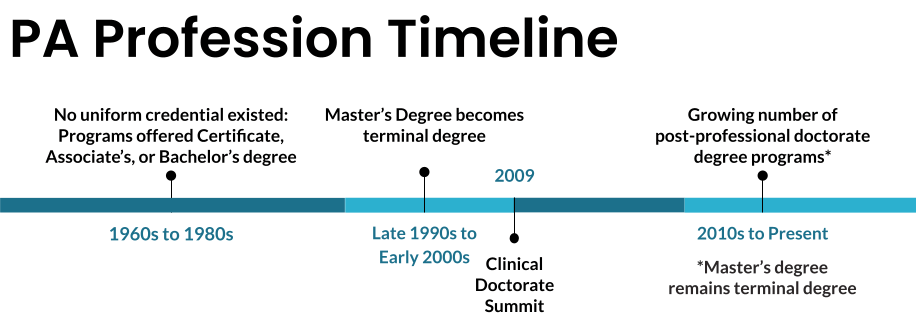
That progression wasn't unique to PAs. Healthcare education has steadily become more rigorous over the past several decades as medicine itself has become increasingly complex. But unlike some other professions, the PA profession stopped there. Today, earning a master's degree remains the educational requirement to become a practicing PA. So why are doctoral programs suddenly appearing? The answer has less to do with clinical medicine than you might think.
The Doctorate Debate Isn't Actually New
Although it may feel like a recent trend, conversations about a PA doctorate have been happening for well over a decade. At the 2009 Clinical Doctorate Summit, a collaboration between the Physician Assistant Education Association (PAEA) and the American Academy of PAs (AAPA), leaders across the profession asked an important question: Should PAs transition to an entry-level doctoral degree?
Their conclusion was surprisingly clear. Rather than recommending an entry-level doctoral degree, the summit supported maintaining the master's degree as the profession's entry-level credential while encouraging the development of post-professional doctoral programs for PAs interested in leadership, education, research, and administration.²
That position has remained relatively consistent. Professional organizations have continued to support optional post-professional doctorates without recommending that every future PA earn a doctorate before entering practice.³
In other words, the debate isn't about whether doctoral education should exist. It's about whether it should ever become necessary.
Why Is This Conversation Heating Up Now?
Part of the answer lies outside the PA profession. Several healthcare professions have transitioned to doctoral-level education as their standard entry credential. Physical therapists now graduate with the Doctor of Physical Therapy (DPT). Pharmacists earn the Doctor of Pharmacy (PharmD). Nurse practitioners increasingly complete the Doctor of Nursing Practice (DNP), particularly as many nursing schools have shifted toward doctoral education.
That naturally leads to comparisons. If many of our healthcare colleagues now hold doctoral degrees, should PAs do the same?
The conversation is becoming more visible as the educational landscape changes. More post-professional PA doctorate programs exist today than ever before, and some PA programs are exploring integrated or bridge pathways. While these models remain uncommon, they've made the discussion feel much more immediate than it did a decade ago.
Supporters see several advantages. A doctorate could better prepare PAs for leadership roles, education, research, health policy, and administrative positions. Some also believe it could improve parity with other doctoral-prepared healthcare professionals. Critics, however, raise equally important concerns: What would PAs gain by making a doctorate the entry-level degree?
Why Some PAs Remain Hesitant
One strength of the PA profession has always been its relatively efficient pathway into clinical practice while maintaining rigorous clinical training. Requiring an entry-level doctorate would likely increase both the length and cost of PA education.
Current evidence has not demonstrated that an entry-level PA doctorate improves clinical outcomes, expands scope of practice, or changes prescribing authority. Critics also worry that longer, more expensive educational pathways could increase student debt, reduce workforce diversity, and move the profession away from its original mission.⁴
And educational costs are becoming an even bigger consideration.
Beginning in 2026, new federal student loan rules place limits on borrowing for graduate education and phase out new Graduate PLUS loans for many borrowers. While the long-term impact on PA education is still unfolding, future PA students may have fewer federal financing options available than previous generations.⁵
That makes conversations about educational value and return on investment even more important. Whether you're considering PA school itself or an optional post-professional doctorate years down the road, understanding the financial commitment has never been more relevant.
Today's master's-trained PAs are exceptionally well prepared for clinical practice. The debate around doctoral education isn't about whether current PA education is inadequate. It's about whether additional education serves different career goals.
So...Do You Need to Worry?
This is probably the question most readers actually came here to answer. If you're a practicing PA or a PA student wondering whether your degree will soon become obsolete, the good news is this:
No, not based on where the profession stands today.
Right now, a master's degree remains the standard entry-level credential for the PA profession. Today's PA doctoral programs are post-professional degrees designed for practicing PAs who want additional education in areas like leadership, education, administration, quality improvement, health policy, or research.
Earning one does not change your scope of practice or prescribing authority, and for the vast majority of clinical positions, it isn't required. That doesn't mean doctoral education lacks value. It simply means its value depends heavily on where you want your career to go, which we’ll explore in Part 2.
As someone who ultimately chose to pursue a PA doctorate myself, I can tell you the answer isn't as simple as "yes" or "no." Whether it was worth it has everything to do with where my career ultimately took me.
The Bigger Question
Perhaps the better question isn't whether every PA should earn a doctorate. It's whether one aligns with the career you hope to build.
That's where we'll pick up in Part 2, exploring what today's PA doctoral programs actually teach, what they cost, and who might find the investment worthwhile for their future.
References:
-
Kayingo G, Kibe L, Venzon A, et al. Demand and supply for doctoral-prepared PA faculty: A 5-year national longitudinal study.. JAAPA. 2021;34(12):1–1. Link
-
Miller AM, Coplan B. Assessing the economics of an entry-level physician assistant doctoral degree. J Physician Assist Educ. 2022;33(1):34–40. Link
-
Kulo V, Fleming S, Gordes KL, et al. A physician assistant entry-level doctoral degree: More harm than good? BMC Med Educ. 2021;21(1):274. Link
-
Fleming S, Kayingo G, Gordes KL, et al. Would transitioning to an entry-level doctoral degree negatively affect PA profession diversity? JAAPA. 2021;34(12):1. Link
-
U.S. Department of Education. One Big Beautiful Bill Act Updates. Federal Student Aid. Updated July 6, 2026. Accessed August 4, 2026. Link

Practice-Changing Education
Experience education that goes beyond theory. Explore Hippo Education’s offerings below.