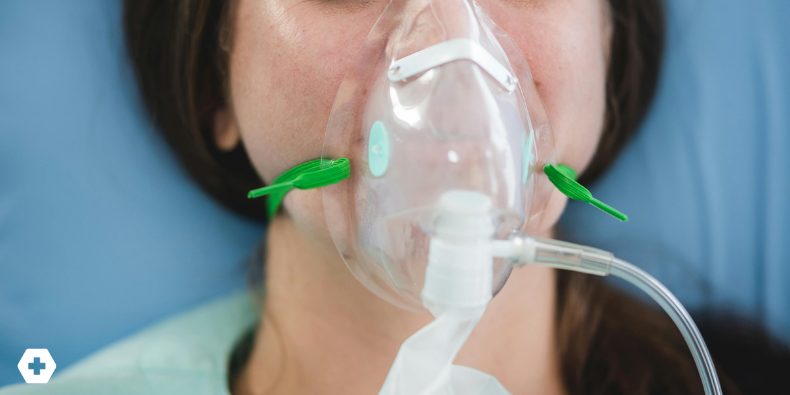

A patient walks into urgent care short of breath.
Their pulse ox reads 88%.
You place them on 2 liters by nasal cannula. The saturation climbs to 92%.
Problem solved, right? Maybe. Maybe not.
One of the easiest traps in respiratory care is treating the pulse oximeter rather than the patient. Oxygen can improve a number on a screen while the underlying physiology continues to worsen. That's why understanding oxygen delivery systems isn't just about memorizing flow rates and FiO₂ ranges. It's about recognizing when a patient's oxygen needs are telling you they're getting sicker.
In urgent care, oxygen is often a bridge. The question is whether you're bridging a patient toward recovery or bridging them until EMS arrives.
Three Terms Worth Untangling
First, let's clarify three concepts that are often lumped together.
-
FiO₂ is the fraction of inspired oxygen. It's simply the concentration of oxygen you're delivering.
-
Oxygenation is what happens in the lungs. Are oxygen molecules successfully crossing from the alveoli into the bloodstream?
-
Ventilation is whether the patient is moving air in and out effectively. In other words: are they getting rid of carbon dioxide?
The distinction matters because oxygen treats hypoxemia. It does not fix hypoventilation. A patient with worsening carbon dioxide retention can have a reassuring oxygen saturation while their mental status deteriorates. That's a dangerous setup if we're only watching the monitor.
The Oxygen Ladder²,³
Most of us think about oxygen delivery as a ladder. As the patient's needs increase, we climb higher.
Nasal Cannula: The Workhorse
For stable patients with mild hypoxia, the nasal cannula remains the standard starting point.
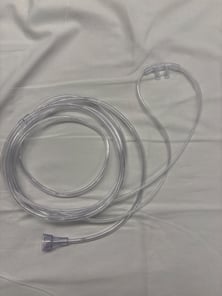
A helpful rule of thumb is that every 1 L/min increase in flow rate increases FiO₂ by about 4%, starting from room air at 21%.
- 1 L/min ≈ 25%
- 2 L/min ≈ 28%
- 3 L/min ≈ 32%
- 4 L/min ≈ 36%
- 5–6 L/min ≈ 40–44%
Nasal cannulas are comfortable, easy to use, and familiar to everyone. But they're limited.
When patients remain tachypneic, use accessory muscles, become altered, or fail to improve despite 4–6 liters of oxygen, it's time to consider alternatives and escalate your management.
Simple Face Mask: The Middle Ground
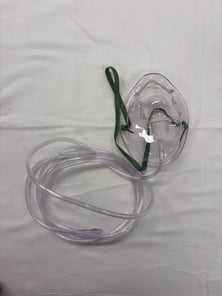 Simple face masks don't get much attention, but they can be useful for patients who need more oxygen than a cannula can reasonably provide.
They typically run at 5–10 liters per minute and deliver approximately 40–60% FiO₂.
★ Flow rates should never be below 5 liters per minute. Lower flows allow exhaled carbon dioxide to accumulate in the mask and get rebreathed.
Simple masks are often appropriate for moderate hypoxia, patients breathing primarily through their mouths, or patients who aren't improving with a nasal cannula.
But they have limitations. FiO₂ delivery remains variable, and the improved saturation can sometimes create a false sense of security if the patient's work of breathing continues to worsen.
Non-Rebreather: The Warning Sign
Non-rebreathers use one-way valves and a reservoir bag to deliver high concentrations of oxygen, often achieving 60–90% FiO₂ when run at 10–15 liters per minute.
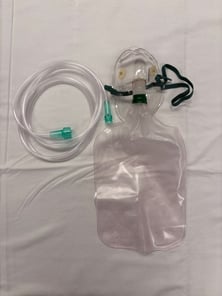
★ The reservoir bag should remain inflated. If it's collapsing during inspiration, the flow rate isn't keeping up with the patient's demand.
Clinically, the non-rebreather often represents more than just a device choice.
It represents a change in risk.
Many urgent care clinicians should follow a simple mental model: if the patient needs a non-rebreather, you should be strongly considering EMS activation. Not because the mask itself is dangerous, but because the physiology that requires it usually is.
Oxygenation Failure Versus Ventilation Failure⁴

One useful bedside framework is asking yourself whether you're looking at an oxygenation problem, a ventilation problem, or both.
Oxygenation Failure
These patients struggle to get oxygen into the bloodstream.
Common clues:
-
Tachypnea
-
Increased work of breathing
-
Retractions
-
Nasal flaring
-
Anxiety or agitation
-
Crackles or other findings suggesting lung pathology
Initially, hypoxia causes agitation, and patients often appear restless, anxious, and air hungry.
Ventilation Failure
These patients struggle to move air effectively and eliminate carbon dioxide.
Common clues:
-
Somnolence
-
Fatigue
-
Confusion
-
Shallow respirations
-
Decreased chest rise
-
Signs of respiratory muscle exhaustion
Another classic pearl:
Hypercapnia causes obtundation. When patients become sleepy, difficult to arouse, or progressively confused, think CO2 retention until proven otherwise.
This is where clinicians can get falsely reassured. Supplemental oxygen may improve saturation numbers while the patient's ventilation continues to deteriorate.
You Don't Have to Climb the Ladder One Rung at a Time
We sometimes teach oxygen devices as a progression, but real life isn't always that orderly.
If a patient is clearly in severe respiratory distress, there's no prize for gradually working through every oxygen delivery system in the building.
Match the device to the severity of illness. A patient gasping for breath with profound hypoxia doesn't need a trial of 2 liters via nasal cannula. They need the highest FiO₂ available while you arrange definitive care.
A Special Note About Kids
Pediatric patients deserve their own warning label. Children are remarkably good at compensating, until they aren't.
A child may maintain a seemingly reassuring oxygen saturation while working incredibly hard to breathe. Persistent tachypnea, retractions, decreased interaction, or signs of fatigue should immediately raise concern.
In pediatric respiratory illness, fatigue is an emergency.
When Should You Call EMS?
Some clear triggers for EMS activation include:
-
Escalating oxygen requirements
-
Need for a non-rebreather mask
-
Respiratory rate greater than 30
-
Tripod positioning
-
Inability to speak in full sentences
-
Altered mental status
-
Somnolence or confusion
-
Hypotension
-
Any concerning worsening trajectory
Always remember, if your clinical intuition says the patient is deteriorating, that's meaningful data.
The Bottom Line
Oxygen therapy is one of the most common interventions we perform in urgent care, but its value extends beyond improving saturation. And a patient whose oxygen requirements continue to escalate is telling you something important, even if the pulse oximeter looks better. Supplemental oxygen is a bridge, not a destination. Continue to identify why the patient requires supplemental oxygen. The real question isn't whether the saturation improved. It's whether the patient did.
References:
- Hardavella G, Karampinis I, Frille A, Sreter K, Rousalova I. Oxygen devices and delivery systems. Breathe (Sheff). 2019;15(3):e108-e116. doi:10.1183/20734735.0204-2019
- Rengasamy S, Nassef B, Bilotta F, Pugliese F, Nozari A, Ortega R. Administration of supplemental oxygen. N Engl J Med. 2021;385(2):e9. doi:10.1056/NEJMvcm2035240
- Weekley MS, Lobo CM, Bland LE. Oxygen therapy. In: StatPearls. StatPearls Publishing; 2025. Updated January 22, 2025. Accessed August 28, 2026. https://www.ncbi.nlm.nih.gov/books/NBK551617/
- Batool S, Garg R. Appropriate use of oxygen delivery devices. Open Anesthesiol J. 2017;11:35-38. doi:10.2174/1874321801711010035

Practice-Changing Education
Experience education that goes beyond theory. Explore Hippo Education’s offerings below.
Urgent Care Reviews and Perspectives
Your monthly dose of must-know urgent care insights, from clinicians you trust.