
When you’re deep into MOCA-Peds questions, few things can spike your heart rate faster than a lab value that doesn’t quite fit or a bleeding history that feels just a little too complicated for a “pick-the-best-answer” moment. Coagulation disorders live right in that space: high-stakes, detail-heavy, and absolutely fair game for exams. Whether it’s a bruising toddler, a teen with heavy menses, or an unexpected post-op bleed, these are the cases that make us pause, think, and double-check ourselves.
That’s why we’re excited to share a sample chapter from Hippo Education’s MOCA-Peds 2026 eBook, focused on helping you confidently understand the differential diagnosis, evaluation, and management of coagulation disorders. This chapter walks you through the “why” behind abnormal bleeding, how to approach the workup without spiraling, and what management actually looks like in practice — starting with pearls and building into a clear, clinically grounded framework. It’s a small taste of how the full eBook is designed to support you: practical, reassuring, and built for pediatricians who want to feel steady and prepared when the questions (or patients) get complex.
Understand the differential diagnosis, evaluation, and management of coagulation disorders
Pearls
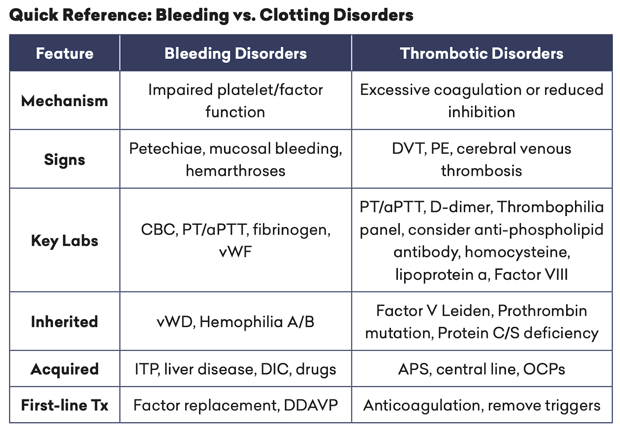
- Pediatric coagulation disorders span from problems with bleeding to clotting.
- Recognizing the pattern of bleeding helps localize the defect to platelets, clotting factors, or regulatory protein.
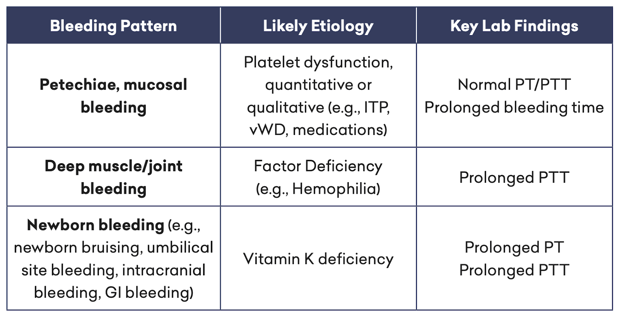
- Petechiae and mucosal bleeding suggest platelet or vascular causes; deep hematomas and hemarthroses point to coagulation factor deficiencies (e.g., hemophilia).
- The most common inherited bleeding disorder is von Willebrand disease (vWD); the most common inherited thrombophilia is Factor V Leiden.
- Prolonged PT = extrinsic pathway defect (vitamin K deficiency, liver disease); prolonged aPTT = intrinsic pathway abnormality (hemophilia, lupus anticoagulant)
- Initial management focuses on stabilization, early labs (CBC, PT/aPTT), and targeted consultation with factor replacement for bleeding or anticoagulation for clotting.
Background
- Coagulation disorders arise from abnormalities in platelets, clotting factors, or fibrinolytic regulation, leading to either bleeding or thrombosis.
- Epidemiology
- Bleeding disorders
- von Willebrand disease is the most common inherited bleeding disorder.
- Clotting disorders
- Pediatric venous thromboembolism (VTE) is rare (0.07–0.49 per 10,000 children) but increasing due to central lines, infection, malignancy, and hospitalization
- Understanding the physiology of hemostasis allows rapid recognition and treatment of these conditions in children.
- Normal hemostasis
- Primary hemostasis: platelet adhesion and aggregation form the initial plug
- Secondary hemostasis: the coagulation cascade generates fibrin to stabilize the clot
- Fibrinolysis: controlled breakdown prevents excessive clot formation
- Disruption of any phase can result in bleeding (impaired clot formation) or clotting (excess activation or failure to regulate).
Types of coagulation disorders
Bleeding disorders
- Quantitative platelet disorders
- Thrombocytopenia = platelets <150,000/µL
- Decreased production, increased destruction, or sequestration
- Common causes
- Immune thrombocytopenia (ITP): post-viral, isolated thrombocytopenia
- Bone marrow suppression: aplastic anemia, leukemia
- Consumption: disseminated intravascular coagulation (DIC), sepsis
- Congenital: Wiskott-Aldrich, TAR syndrome
- Clinical findings
- Petechiae, purpura, mucosal bleeding
- Deep hematomas are uncommon
- Qualitative platelet disorders
- Normal count, abnormal function
- Inherited: Glanzmann thrombasthenia (GpIIb/IIIa defect), Bernard-Soulier (GpIb defect)
- Acquired: uremia, liver disease, aspirin or NSAID use
- Coagulation factor deficiencies
-
- Hemophilia A (Factor VIII) and B (Factor IX)
-
-
- X-linked recessive
-
-
-
- Severity correlates with factor activity (<1% severe, 1–5% moderate, >5% mild)
-
-
-
- Clinical findings: deep tissue bleeding, hemarthroses
-
-
- Hemophilia C (Factor XI)
-
-
- Autosomal recessive
-
-
-
- Mild
-
-
- Acquired
-
-
- Vitamin K deficiency
-
-
-
- Liver dysfunction
-
-
-
- Anticoagulant exposure
-
- Von Willebrand Disease (vWD)
-
- Deficiency or dysfunction of vWF impairs platelet adhesion and reduces Factor VIII
-
- Types:
-
-
- Type 1 (quantitative)
-
-
-
- Type 2 (qualitative)
-
-
-
- Type 3 (absent)
-
-
- Clinical findings: epistaxis, menorrhagia, mucosal bleeding, post-procedural bleeding
Thrombotic disorders
- Inherited thrombophilias
-
- Factor V Leiden
-
-
- Activated Protein C resistance (most common inherited cause) → decreased natural anticoagulant activity
-
-
- Prothrombin G20210A mutation
-
-
- Increased thrombin generation
-
-
- Protein C, S, or Antithrombin III deficiency
-
-
- Decreased natural anticoagulant activity
-
-
- Other contributors: elevated Factor VIII, lipoprotein(a), homocysteine
- Acquired thrombophilias
-
- Lupus anticoagulant/antiphospholipid antibody syndrome
-
-
- Prolonged aPTT that fails to correct on mixing
-
-
-
- Paradoxical thrombosis (prolonged PTT but paradoxically is prone to clotting instead of bleeding!)
-
-
- Central venous catheter-associated thrombosis
-
-
- Most common in hospitalized children
-
-
- Other triggers: estrogen-containing contraception, trauma, infection, surgery, malignancy, obesity
Evaluation
- History
- Family history of bleeding or clotting disorders
- Neonatal bleeding (e.g., umbilical stump, circumcision)
- Medications (e.g., aspirin, NSAIDs, anticoagulants, estrogen containing contraception)
- Triggers: infection, trauma, surgery, estrogen, immobility
- Physical exam
- Distribution of bleeding - mucosal vs. deep tissue
- Mucosal bleeding → consider platelet/vWF defect
- Deep tissue bleeding → consider coagulation factor defect
- Signs of systemic illness (e.g., hepatosplenomegaly, lymphadenopathy)
- Limb swelling or redness suggesting DVT
- Laboratory testing
-
- For easy bleeding
-
-
- Initial lab tests should include:
-
- Complete blood count (CBC) with platelet count → to assess for thrombocytopenia and evaluate red and white cell morphology
- Prothrombin time (PT) and activated partial thromboplastin time (aPTT) → to screen for defects in the extrinsic and intrinsic coagulation pathways, respectively
- Von Willebrand factor (VWF) antigen and VWF activity (ristocetin cofactor assay) → to evaluate for von Willebrand disease
- Factor VIII and Factor IX activity levels → to detect hemophilia A and B
-
- Further testing is guided by initial results and clinical suspicion:
- Platelet function assays (PFA-100, aggregation studies) for qualitative platelet disorders
- Specific factor assays for rare deficiencies
- Fibrinolytic defect testing if bleeding is unexplained and initial workup is negative
- For thrombosis
-
- Initial lab tests should include:
- Lupus anticoagulant and antiphospholipid antibody panel (if thrombosis or prolonged aPTT)
- Thrombophilia panel:
- Factor V Leiden
- Prothrombin mutation
- Protein C/S
- Antithrombin III
- Homocysteine
Management overview
Bleeding disorders
-
- Hemophilia A
- Recombinant Factor VIII or emicizumab prophylaxis
- Hemophilia B
- Factor IX replacement
- vWD
- Type 1: DDAVP (Type 1)
- If severe: vWF concentrate
- ITP
- Prior treatment guidelines based on absolute platelet counts are no longer recommended → symptoms and other patient characteristics now drive the decision making process:
- Observe if platelets >30,000/µL
- Steroids or IVIG for symptomatic bleeding
- DIC
- Treat underlying cause
- Replace platelets/fibrinogen as indicated
- Avoid: aspirin/NSAIDs, IM injections, unnecessary invasive procedure
Thrombotic disorders
- Anticoagulation
- Initial: low molecular weight heparin (LMWH) or direct oral anticoagulation (rivaroxaban, apixaban)
- Duration: 3 months (provoked); 6–12 months if unprovoked or persistent risk
- Address triggers
- Remove central lines, stop estrogen therapy, treat infection
- Long-term
- Genetic counseling for inherited thrombophilia
- Non-estrogen contraception
- Hematology follow-up

Practice-Changing Education
Experience education that goes beyond theory. Explore Hippo Education’s offerings below.