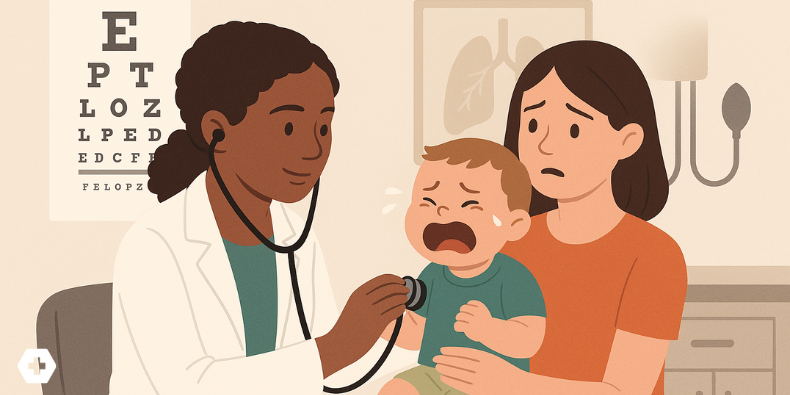
Demystifying the Peds PE

Whether you’re in primary care, urgent care, or the ED, the pediatric physical exam can be challenging. Adult vitals make sense. Adults generally cooperate. But kids? They squirm, scream, and sometimes can’t even tell you where it hurts. The pediatric exam isn’t just smaller, it’s a different beast altogether.
But with the right mindset and a few practical strategies, it doesn’t have to be daunting. Here are three core principles to help you approach the pediatric exam with more confidence and a lot less stress.
1. Get Oriented Before You Walk Into the Room
Before you even say hello to the patient, you’re already doing your exam.
Start at the doorway. Observe the child’s position, color, and interaction. Are they playing with a toy? Clinging to a parent? Sprawled out on the gurney, uninterested and listless? These first few seconds can provide valuable insights into tone, perfusion, and respiratory effort — the pediatric assessment triangle in action.
Next, take a close look at the vitals, but with pediatric guardrails in place. Unlike adult norms, vital signs change with age, and a single number out of context can be misleading.
Here’s a quick cheat sheet:
-
Heart Rate: Up to 220 beats per minute can be normal for a crying infant. But a resting HR over 230 — or under 90 in a newborn — needs immediate attention.
-
Respiratory Rate: Up to 60 is acceptable in infants, but anything over that should raise concern.
-
Blood Pressure: Use the minimum systolic rule: 70 + (age × 2) = red flag threshold.
Also, consider the context. Was the child crying during vitals? Is the pulse ox reading 100% with a strong waveform? Is the BP cuff the correct size? When it comes to kids' vital signs, it’s all about understanding them and how they were obtained, not just looking at the numbers.
And finally, if the child has calmed down, ask for a repeat set. One set is no set. Reassess once trust (and heart rates) have settled.
2. Use Development, Not the Calendar, to Guide Your Exam
Getting kids to cooperate isn’t automatic, but it's an important stage of development. As children grow, their ability to work with others during play or medical visits shows how they're developing socially and emotionally.
From birth to about 7 months, most babies haven’t developed stranger anxiety. These are the golden months when you can usually get a complete exam with minimal resistance. Take advantage of this window.
But around 8 months and up? Stranger anxiety becomes real. Toddlers aren’t trying to be difficult; they’re doing what their developmental age demands. Screaming, squirming, and hiding are normal behaviors, not exam failures.
The key is to match your approach to the child’s developmental stage:
-
Infants: Examine while they're feeding or being held by a parent. Warm hands. Gentle touch.
-
Toddlers: Sit at their level. Use play. Let them “examine” you first. Always go for the least invasive parts of the exam first (heart and lungs before ears and throat).
-
School-age kids: Often cooperative, but respect their autonomy. Ask before touching.
-
Teens: Engage them directly. Don’t ignore them in favor of the parent. Offer privacy and control wherever possible.
Also, remember that development is part of the exam itself. Motor milestones follow a predictable pattern: head-to-toe and proximal-to-distal. A baby should pick up their head before they sit, sit before they crawl, crawl before they stand, and stand before they walk. When those milestones are delayed or lost, that’s a red flag. Especially in kids with headaches, vomiting, or neurologic symptoms, ask about developmental regression. If a child used to walk, talk, or play and now doesn’t, that deserves immediate attention.
3. Be Strategic, and a Little Sneaky, With the Physical Exam
You don’t need to “win over” a toddler. You need to outsmart them.
Success in the pediatric physical exam hinges on two key factors: positioning and timing.
For ears: Lay the child down in “intubation position”, head near you, ear up. Have a caregiver gently restrain the arms. Use a small speculum to gently pull the pinna back and slightly upward. You may not get a perfect view all at once. That’s okay. Scan like you’re sweeping a spotlight across the tympanic membrane.
For the mouth: Use the same position. Gently insert the tongue depressor on the side, wait for them to cry, then peek while the mouth is open. Use your pinkies to stabilize the jaw.
For lungs: Listen early, before crying or screaming. Try localizing where an abnormal breath sound may be coming from. Place your stethoscope at the nose, the neck, and the chest. The loudest spot tells you where it’s coming from.
For the abdomen: Minimize tickling by using the pads of your fingers (not fingertips), and flex their knees to soften the abdominal wall. If they’re too tense, let them place their hands under yours. Bonus trick: ask them to jump. No peritonitis? That’s good data.
For genito/urinary exams: Always have a chaperone. Explain to both the parent and the child exactly why the exam is needed, what you’ll be doing, and how long it will take. Make it about safety and trust.
And if the child is too upset to examine? Step out. Finish your chart. Come back in 10.
The Bottom Line
- The pediatric exam doesn’t have to be a battle. It’s a dance, one that changes rhythm depending on the age, the context, and the mood of your tiny patient.
- Be observant. Be flexible. Be honest. And know that it’s okay to be a little goofy if it gets the job done.
- Kids might be small, but their exams are big in value.

Practice-Changing Education
Experience education that goes beyond theory. Explore Hippo Education’s offerings below.